What most visitors never realise about Ibiza
Ibiza is small. Roughly 40 kilometres end to end – the kind of number that sounds like a weekend, not a destination. And yet.
Squeeze that geography into a Mediterranean island, throw in limestone cliffs dropping straight to the sea, pine forests thick enough to block the sun, salt flats that turn pink at dusk, and villages so old they predate the concept of tourism entirely – and 40 kilometres starts to feel like a lot. Like, a genuinely surprising amount, actually.
The problem is that most of it stays hidden. You don’t see it from a pool terrace or a beach club. You don’t find it on the shuttle from the airport. It’s the kind of place that only shows itself when you’re moving through it slowly, window down, with no particular deadline.
The travellers who come back to Ibiza year after year – the ones who talk about it like it got into their bloodstream – are almost always the ones who drove. Not a transfer. Not a taxi between venues. A real drive, through the interior, along the northern coast, past Es Vedrà at that specific hour when the light goes amber and everything looks slightly unreal.
For anyone ready to look past the obvious, the best way to explore Ibiza by car is simple: pick a direction. The island handles the rest.
The north: where Ibiza holds its breath
There’s a version of this island that the locals don’t advertise. It lives in the north – specifically in the stretch between Sant Joan de Labritja and Portinatx, where the roads narrow, the tourist buses disappear, and the landscape does something unexpected. It softens.
Sant Joan is the place to start. Tiny village, whitewashed church, a couple of terraces with plastic chairs that have been there since roughly 1987. The pace here is borrowed from somewhere older. Nobody seems to be in a hurry, which – after the airport, after the resort strip – feels almost aggressively pleasant.
From Sant Joan, the road winds down toward Benirràs Beach, a half-moon cove that’s earned a quiet kind of fame for its Sunday sunset drum circles. Worth the drive on its own. Though fair warning: the descent is steep, the parking fills early, and the view from the top of the hill before you descend is, honestly, the bit that gets people.
Heading back north toward Portinatx, the road hugs the coast just enough – glimpses of deep blue between the pines, isolated coves far below that are only reachable on foot. Most people don’t bother. That’s rather the point.
A few things worth knowing before this route:
- Past Sant Joan, roads get narrow fast – a compact car is genuinely easier
- Petrol stations thin out up here; fill up in Sant Antoni or Ibiza Town before heading north
- Before 10am, the light is better and the roads are nearly empty
- Sant Miquel de Balansat is 20 minutes off-route and worth every one of them – the fortress church sits on a hill and the views are absurd
The west coast: Es Vedrà and the sunset ritual
If there’s a single scenic drive in Ibiza that has earned its reputation completely and without exaggeration, it’s the approach to Es Vedrà along the western coast.
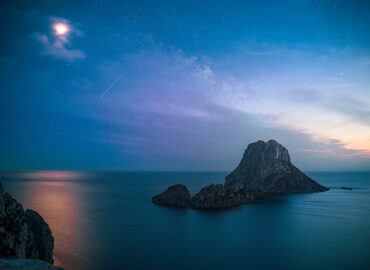
The rock rises 382 metres straight out of the sea. No gradual buildup, no context – just this enormous limestone formation appearing offshore like something that forgot it wasn’t supposed to be there. It’s wrapped in folklore (supposedly the third most magnetically charged place on Earth, allegedly a UFO hotspot, definitely a spot where people take a lot of photographs and then stand quietly for a while).
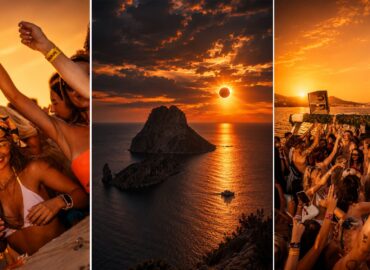
The route runs south from Sant Antoni through Cala Tarida, past Cala d’Hort, ending at the Mirador des Savinar viewpoint. On a clear July evening the rock turns a shade of orange that looks genuinely filtered. It isn’t.
“The road to Es Vedrà is one of those rare drives where you’re forced to stop – not because of traffic, but because what’s in front of you refuses to be ignored,” says travel journalist Sara Moreno, who has written about the Balearics for over a decade.
Cala d’Hort sits just below the viewpoint – pebbles and sand, direct sightline to the rock, busy in high season and considerably better in late September when the tourists thin out and the light gets longer and stranger. September Es Vedrà is a different beast from August Es Vedrà. File that away.
The interior: the Ibiza that time forgot
Nothing quite prepares first-time visitors for the interior. They land expecting the nightlife, the beach bars, the whole White Isle mythology. What they find, once they rent a car in Ibiza and actually head inland, is something else entirely – almond trees, dry-stone walls, the faint smell of rosemary through the window, and villages where the church bell is legitimately the loudest thing going on at noon.
Santa Gertrudis de Fruitera is the right place to start. Pull into the central plaza, find a table, order a café con hielo, and let the morning pass. The village has become – quietly, without making a fuss about it – a favourite with artists, writers, and the kind of people who came for a season and simply never left. There’s a good ceramics studio. A natural wine bar run by someone who moved from Barcelona meaning to stay six months (that was ten years ago). It has that feeling.
From Santa Gertrudis, a loop through Sant Llorenç de Balàfia and back via Can Marca takes under two hours and covers countryside that photographers come back to repeatedly – ancient fincas half-buried in bougainvillea, hillsides dotted with juniper, roads that feel more like suggestions than infrastructure.
The Las Dalias Hippy Market in San Carlos sits on this same route. Open Saturdays year-round, extra nights through summer. It’s touristy – fine, yes, obviously – but it’s also genuinely worthwhile, particularly the Saturday morning flea market section, which has the kind of finds that don’t show up on anyone’s Instagram.
The south: salt flats, Dalt Vila, and the slow road home
The south is stranger. Flatter, wider – the landscape opens up in a way that feels almost unusual after the winding north. The Ses Salines Natural Park covers both coast and salt flats, and the drive along its edge in the late afternoon is oddly cinematic. Flamingos occasionally show up in spring. The light out here scatters differently – more horizontal, somehow, like it’s coming from the wrong direction.
Ibiza Town anchors the south and takes longer to absorb than most people budget for. The old walled city of Dalt Vila – UNESCO World Heritage since 1999 – climbs above the harbour in layers: cobbled alleys, Renaissance fortifications, a cathedral at the very top with views that reach Formentera on a clear day. It deserves an afternoon, not a half-hour.
The eastern coast road back north passes through Santa Eulària des Riu – the island’s most low-key town, built around a river that runs mostly dry by June. The promenade is good at dusk. The marina fills with boats in July and August that look like they belong in a different kind of travel brochure entirely.
Before heading out: the practical stuff
Ibiza road trips are forgiving – the island is small enough that getting slightly lost is more adventure than problem. That said, high season (June through September) means real traffic around the resort areas, and what looks like a 20-minute drive on a map can take considerably longer on a Saturday afternoon in August.
Worth knowing:
- Speed limits: 50 km/h in towns, 90 km/h on open roads – and they’re enforced
- Country roads (caminos) are driveable but sometimes unpaved; check before you commit
- Beach parking near popular spots fills before 9am; arriving late afternoon often works just as well
- GPS is worth taking if renting a car in Ibiza for interior routes – signage in rural areas is sparse and occasionally optimistic
- The 2025 vehicle access regulations affect cars arriving by ferry; rental cars operate under a separate quota and are generally unaffected for most visitors
The main roads are fine. The minor ones vary. A standard compact handles everything on this list without complaint.
The road you didn’t expect to take
There’s a moment that happens – usually somewhere past Santa Gertrudis, around the third or fourth bend into the pine trees – when the road drops and the sea appears suddenly, far below, and completely without warning. It’s the point where the island stops being a destination and starts being a place.
Ibiza is roughly the size of a mid-sized city. But driven slowly, with no deadline and the windows down, it feels significantly bigger than that. The best parts of it – the coves that require a walk, the hilltop churches with unlocked doors, the fincas behind old walls that you pass and immediately want to know the story of – none of those are on any map worth following. They turn up when they turn up.
That’s the version that stays with people. Long after the tan fades and the club nights blur together – it’s usually a specific road, a specific light, a view that appeared without being planned for. That’s what Ibiza does when you actually drive through it.