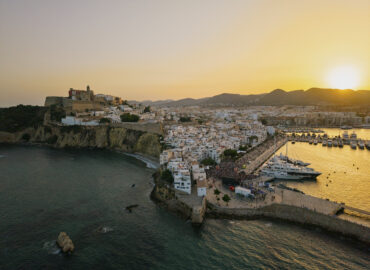
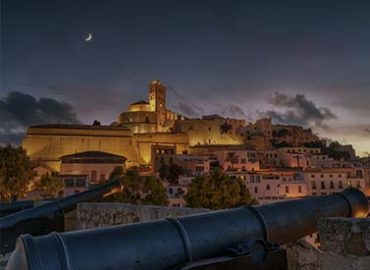
On 12 August 2026, Ibiza witnessed something extraordinary — a total solar eclipse, turning an already beautiful summer evening into a once-in-a-lifetime experience. We watched it unfold from Can Salia, and for a few nervous minutes, it looked as though the clouds might steal the show. Thankfully, they didn’t.


The island is famous for its sunsets, its beaches, its music and the unmistakable energy that arrives every summer. But on Wednesday 12 August, nature put on a spectacle that eclipsed even Ibiza’s legendary sunsets.
The 2026 total solar eclipse was one of the most anticipated astronomical events in decades, and Ibiza found itself in a particularly special position to experience it.
For us, the perfect vantage point was Can Salia, overlooking the Mediterranean.
Waiting for the sky to change
The atmosphere at Can Salia was different from a normal August evening.
Rather than simply waiting for another Ibiza sunset, everyone was watching the sky, cameras were being prepared and people were constantly looking towards the horizon.
The eclipse had been building since around 19:39, as the Moon gradually moved across the face of the Sun. But the most dramatic part was still to come.
In Ibiza, maximum eclipse arrived at approximately 20:33, when the Moon completely covered the Sun for around a minute.
There was just one problem.
The clouds.
As the crucial moment approached, cloud began moving across the sky. For a short period, there was a very real feeling that after waiting and preparing for this extraordinary event, we might actually miss it.
For photographers especially, it was frustrating.
We had our cameras ready. We had the location. We had the view. We had the event of a lifetime happening above us.
And then the clouds arrived.
And then, suddenly, everything changed
Thankfully, the clouds didn’t stay.
At exactly the moment we needed them to move, the sky opened enough for us to see what was happening.
The light began to change dramatically.
The familiar golden Ibiza evening started to disappear and the atmosphere became noticeably darker and cooler. The Sun, already low towards the horizon, was being swallowed by the Moon.
Then came totality.
For roughly a minute, the Sun disappeared behind the Moon and the landscape around us was transformed.
It wasn’t simply a darker sunset.
It was something completely different.
The sky took on an almost surreal quality, the horizon remained illuminated while the area around us fell into an unusual twilight, and for that brief moment the normal rhythm of Ibiza seemed to stop.
A photographer’s perspective
For me, experiencing the eclipse as a photographer made it even more memorable.
There is something particularly challenging about photographing an astronomical event that lasts only moments, especially when it is happening close to sunset and the conditions are constantly changing.
The combination of the eclipsed Sun, the fading daylight, the clouds and the Mediterranean horizon created an incredibly unusual photographic opportunity.
And, ironically, the clouds that had caused so much anxiety beforehand became part of the story.
They added atmosphere and drama to the images, rather than simply ruining the view.
Looking back at the photographs now, they capture something that is difficult to recreate — not just the eclipse itself, but what Ibiza felt like while it was happening.
Ibiza and a very rare celestial event
The 2026 eclipse was particularly significant because Spain was one of the world’s major viewing locations.
The total eclipse crossed a broad section of Spain before reaching the Balearic Islands. Ibiza experienced totality close to sunset, making the event especially unusual because the eclipsed Sun was already very low in the western sky.
Across Ibiza, people gathered at beaches, viewpoints, hotels and coastal locations to watch.
Local astronomy groups also organised dedicated observation points, with the Astronomical Association of Ibiza choosing the Moscarter lighthouse area in Portinatx as one of its viewing locations.
Thousands of people across Ibiza and Formentera came out to experience the phenomenon, with reports describing some last-minute cloud cover but generally successful viewing across the islands.
And that is perhaps what made the experience even more special.
Everyone was looking at the same sky.
One minute that we’ll remember for a lifetime
Totality was brief.
Approximately one minute.
But that is the strange thing about experiences like this. You can spend weeks reading about an eclipse, checking the forecast, planning where to watch it and preparing your camera — and then the defining moment lasts little more than 60 seconds.
Yet it stays with you.
Standing at Can Salia, watching the final light disappear and the Moon completely cover the Sun, was one of those rare moments where everyone simply stopped and looked upwards.
And then, almost as quickly as it arrived, the moment was gone.
The light returned, the Sun began to emerge and Ibiza slowly returned to a stunning sunset finish!
But for those of us who witnessed it, 12 August 2026 will always be remembered as the night Ibiza fell into darkness.
And thankfully, the clouds gave us just enough of a window to see it.
A once-in-a-lifetime experience, photographed from one of Ibiza’s most beautiful coastal settings — Can Salia.